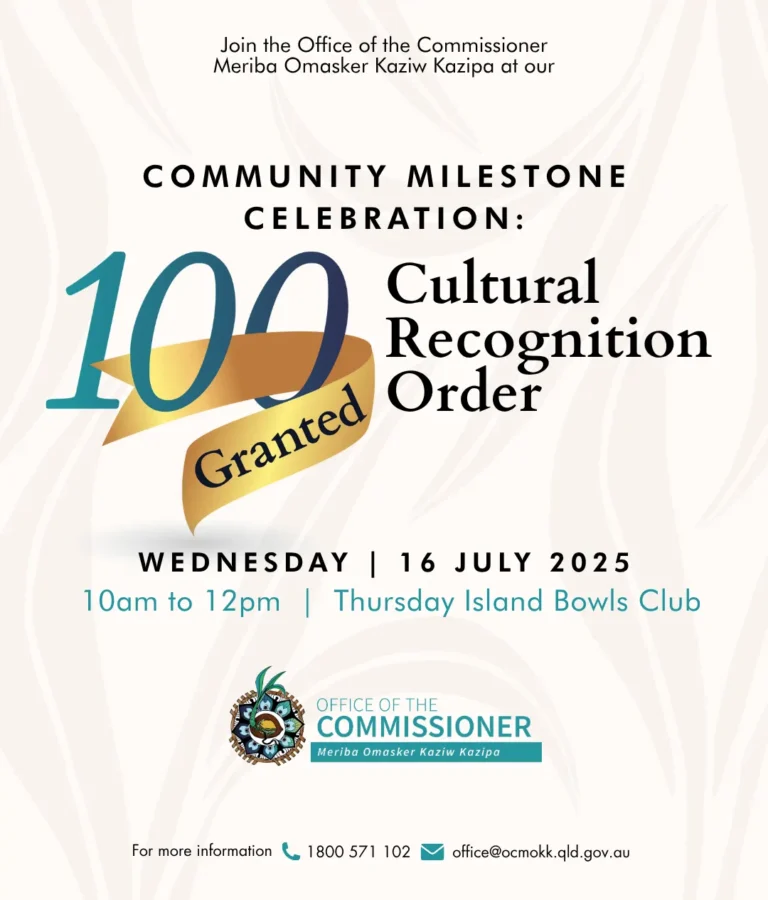
A Waiben (Thursday Island) community event last Wednesday marked a milestone for the Office of the Commissioner Meriba Omasker Kaziw Kazipa (OCMOKK) initiative.
100 cultural recognition orders have been officially granted since the landmark Meriba Omasker Kaziw Kazipa (Torres Strait Islander Traditional Child Rearing Practice) Act 2020 was enshrined in law on 1 July 2021, followed by the first-ever Cultural Recognition Order granted in November 2021.
Four years on and reappointed Meriba Omasker Kaziw Kazipa Commissioner – Meriam and Yidinjdji descendent – Mr C’Zarke Maza acknowledged the historic achievement as nothing short of extraordinary.
“These 100 granted CROs represent more than just numbers, they reflect the stories and lives of over 600 individuals who have meaningfully benefited through their involvement in these applications,” Mr Maza said.
“The journey to legal recognition was over 30 years in the making and in June 2025, we have made history yet again; celebrating the 100th granted Cultural Recognition Order,”
“Meriba Omasker Kaziw Kazipa is a groundbreaking program that aims to heal mepla people, close the gap and recognise the ailan kastom of Zenadth Kes child-rearing practices,” he added.
The Crisafulli Government has delivered a $6.8 million investment to continue the Meriba Omasker Kaziw Kazipa program.
“I am proud to recognise the Crisafulli Government’s funding to continue the important work of the Office of the Commissioner (Meriba Omasker Kaziw Kazipa). This investment reflects a shared commitment to fostering empowerment, self-determination and cultural cohesion across the Torres Strait Islander communities in Queensland. By continuing its support, the Government has reinforced confidence in a program that is not simply a service, it represents our collective journey toward reconciliation,” Mr Masa added.
“Since its establishment, the program has delivered meaningful outcomes: improving access for Torres Strait Islander families to education, health, and government services, while achieving tangible improvements in overall wellbeing. With this funding injection, we are putting real investment behind real outcomes and driving measurable impact, it allows us to continue breaking down barriers to participation, ensuring that families are supported in ways that respect and uphold cultural identity.”
“With this funding, we are turning commitment into action – building stronger foundations for Torres Strait Islander families, preserving cultural integrity, and creating long-term, measurable change. Together we are listening to the voices of our communities and translating this support into pathways for stronger, more inclusive futures where all Torres Strait Islander families feel valued and empowered to raise their children in a way that reflects their cultural identity,” he said.
The Waiben celebrations was attended by families, community and key stakeholders including Anna McGrath AM, Deputy Director-General of Department of Women, Aboriginal and Torres Strait Islander Partnerships and Multiculturalism, Aaron Hoffman, Executive Director of Cultural Economic Participation, Torres Strait Islander Regional Council Mayor Philemon Mosby and Torres Shire Council Mayor Elsie Seriat OAM.
Mayor Mosby said that it was time to rebuild our villages as while it may take a village to raise a child, our villages are being challenged, broken and forgotten.
“We’re living in a time where the songs we sing have just become words because the system of oppression does not deliver what we need or what our Akas and Athes fought for,”
“We see this in the outcome of our children; they are the reason we need to come back to our village,”
“So, I’m deeply humbled to be here today as I have seen the fruit of the labour, of the work by this program and our Elders,”
Mayor Seriat acknowledged her former workplace and colleagues on achieving the significant milestone.
“I had the privilege of working alongside this team as a Cultural Support Officer and I wish to acknowledge the Cultural Support Officers for their dedication to supporting yumi families in obtaining a Cultural Recognition Order,”
“Today, we’ve heard stories from our Elders and members of the Kupai Omasker Working Party about how sacred this practice is for us, and the importance of ensuring all families are recognised in Queensland law,”
Eminent members of the Kupai Omsaker Working Party and the Meriba Omsaker Kaziw Kazipa Advisory Group participated in the festivities, yarning with families and resharing powerful stories of the journey to legal recognition.
Kai kai, Traditional Island Dancing and storytelling were key features of the day, allowing families to reflect on the achievements of Torres Strait Islanders throughout history, and acknowledge leaders like Mayor Mosby and Mayor Seriat who are committed to supporting a brighter future for our children’s children.
In his closing, Mr Maza thanked the Meriba Omasker Kaziw Kazipa Cultural Support Officers, reiterating their commitment to supporting families on their journey to cultural recognition.
“This achievement wouldn’t have been possible without the dedication of our Cultural Support Officers, who have walked closely with families, acting as cultural liaisons and advocates. Their commitment to standing in that space – between community, culture, and the legal system – is truly commendable,
“I also thank our key stakeholders, including Legal Aid Queensland and Births Deaths and Marriages Queensland for their ongoing support,”
“Finally, mina big eso to our guiding Elders; the Kupai Omasker Working Party and the Meriba Omasker Kaziw Kazipa Advisory Group for their unyielding vision, support and wisdom,” Mr Maza said.
The Meriba Omasker Kaziw Kazipa program support offices are located at:
Level 3 CitiCentral Building, 46-48 Sheridan Street, Cairns Qld
Level 1 Torres Haus, 46 Victoria Parade, Thursday Island Qld
For more information, free call 1800 571 102, email office@ocmokk.qld.gov.au or visit www.ocmokk.qld.gov.au