
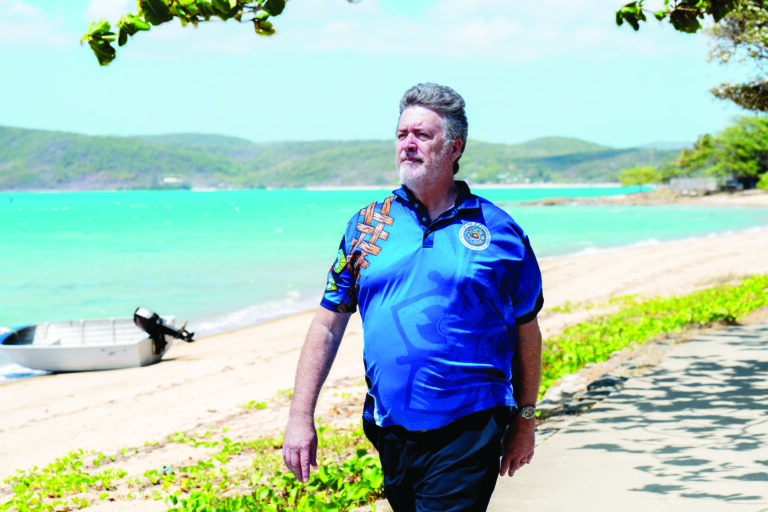
The Office of the Commissioner Meriba Omasker Kaziw Kazipa (OCMOKK) has appointed senior lawyer Peter Krebs as its new Independent Legal Advisor, strengthening support for Torres Strait Islander families seeking legal recognition of their traditional child-rearing practices.
With more than 16 years of experience working with Torres Strait Islander organisations and communities, Mr Krebs is a familiar face to many families, having held positions in Native Title with the Torres Strait Regional Authority (TSRA) and legal advisor to the Torres Strait Island Regional Council (TSIRC).
Now with OCMOKK, Mr Krebs brings his legal expertise and evolving understanding of Ailan Kastom to help families navigate the Cultural Recognition Order (CRO) process, ensuring they understand their rights, responsibilities and the legal implications of their decisions.
His appointment comes as OCMOKK continues to support a growing number of Torres Strait Islander families seeking legal recognition of their cultural child-rearing practices.
To date, 147 Cultural Recognition Orders have been granted since the legislation commenced in July 2021, benefiting more than 880 people.
This year, 46 CROs were granted, with over 573 enquiries from families seeking information and support.
Commissioner C’Zarke Maza welcomed Mr Krebs, recognising the value of his experience and longstanding relationship with Torres Strait Islander communities.
“Providing families with independent legal advice is vital to safe guarding the practice and ensuring families understand any legal implications,” Mr Maza said.
“Of the 46 Cultural Recognition Orders granted this year, 21 required additional court proceedings to address consent requirements, highlighting the importance of accessible and independent legal assistance for families navigating more complex applications,”
“Peter’s appointment therefore ensures families speak to a familiar face at any point in their journey towards legal recognition,”
“While working within the OCMOKK offices, Peter’s role operates behind an ethical wall, allowing him to confidentially support families with independent legal advice, separate from the operations of our program office,” Mr Maza explained.
Under the Meriba Omasker Kaziw Kazipa (Torres Strait Islander Traditional Child Rearing Practice) Act 2020, eligible Torres Strait Islander families can apply for a Cultural Recognition Order (CRO) that legally recognises an existing cultural parent-child relationship.
A CRO enables a person’s birth certificate to reflect their cultural parentage, helping families overcome challenges when accessing education, healthcare, identification documents, government services and other legal entitlements.
For Mr Krebs, the role is an opportunity to continue working alongside Torres Strait Islander families while contributing to the recognition and protection of Ailan Kastom.
“It’s been my privilege to work within the Torres Strait, and I’ve had a lot of enduring friendships that have resulted from it,” Mr Krebs said.
“Through my work in Native Title, I understand a lot about the traditional practices and Ailan Kastom, and how it’s integral to life in the Torres Strait.”
Mr Krebs said his approach would recognise the different circumstances and cultural practices of families across the region.
“Every family situation is different, of course, and we recognise the fact that what is tradition in one part of the Torres Strait may not be necessarily so in the other,” he said.
“Each family’s journey will be different. My role is to assist the families to reach that end goal of getting that Cultural Recognition Order.”
Working alongside OCMOKK’s Cultural Support Officers, Mr Krebs will provide confidential legal advice, assist with application requirements and support families through court proceedings where necessary.
He will also be available to meet families face-to-face, over the telephone or online, recognising the challenges of accessing legal services across the Torres Strait.
For families who have been considering applying for a Cultural Recognition Order, Mr Krebs encouraged them to contact OCMOKK to learn more about the process.
“Anybody can ring the office, get the advice, so that they can actually make a decision whether it’s appropriate in their circumstances to seek a Cultural Recognition Order,” he said.
OCMOKK remains committed to ensuring Torres Strait Islander families can access culturally appropriate, confidential and informed support throughout their journey towards legal recognition.